Last reviewed: January 2025 · Verify rules with your county before starting any project.
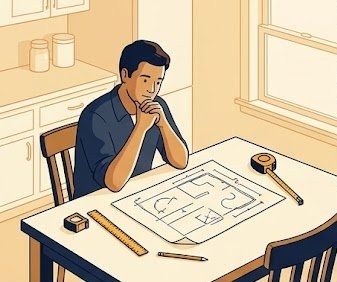
Every permit application starts with a site plan — here's how to prepare.
The question homeowners ask most before buying a shed: do I need a permit? The answer depends entirely on your county — and it varies more than most people expect. A 12×16 shed (192 sq ft) requires a permit in Gwinnett County, Georgia but not in Wake County, North Carolina. Understanding how these thresholds work — and why they exist — helps you avoid a costly mistake before you spend money on a structure.
How Shed Permit Thresholds Work
Building permits in the United States are regulated at the local level — counties and municipalities adopt versions of model building codes (usually the International Residential Code, or IRC) and add their own amendments. The IRC itself allows jurisdictions to exempt small accessory structures from the permit requirement, but leaves the exact threshold up to each jurisdiction to define.
This is why you'll see such wide variation. Common thresholds in use across the country:
- No exemption: Cherokee County (GA), Prince George's County (MD), Henry County (GA) — all sheds require a permit
- 120 sq ft: Fulton County (GA), DeKalb County (GA), Orange County (FL), Hillsborough County (FL)
- 144 sq ft: Gwinnett County (GA), Williamson County (TN), Cobb County (GA), Forsyth County (GA)
- 200 sq ft: Hall County (GA), Mecklenburg County (NC), Davidson County (TN), Jefferson County (CO)
- 256 sq ft: Wake County (NC), Durham County (NC), Fairfax County (VA), Loudoun County (VA)
Setback Rules Apply Even Without a Permit
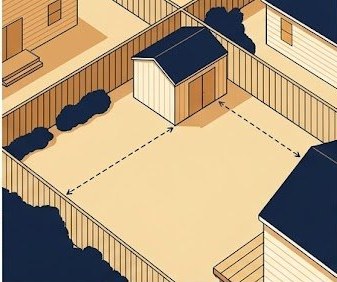
Typical rear and side setbacks for a residential shed — measurements are from the structure to the property line.
This is the most commonly misunderstood aspect of shed placement: even if your shed is small enough to be permit-exempt, you still must comply with setback requirements. Setbacks define how close to a property line a structure can be placed. Violating setbacks — even for an unpermitted shed — can force you to move or remove the structure.
Typical setback rules for accessory structures across most US counties:
- Rear yard: 5–10 feet from the rear property line
- Side yard: 5 feet from side property lines
- Front yard: Sheds generally not permitted in front yards
- Distance from house: At least 6 feet from any other structure
Always confirm your specific county's setbacks before placing a shed. Use your county's GIS tool (searchable by property address) to see your lot's dimensions and zoning district.
Pre-Built Sheds Follow the Same Rules
A common misconception: if you buy a pre-built shed from a retailer and have it delivered on a trailer, no permit is needed. This is false in most jurisdictions. Counties apply the same permit rules to pre-built structures as to site-built ones. The only thing that matters is the shed's size and your zoning district — not how it was assembled. Many big-box retailers and shed vendors do not inform buyers about permit requirements, so the responsibility falls on the homeowner.
What the Permit Process Looks Like for a Shed
If your shed requires a permit, here's the typical process in most counties:
- Application: Submit a permit application online or in person, with property address, project description, and estimated value.
- Site plan: Provide a site plan showing your property lines, existing structures, and the proposed shed location with setback measurements clearly labeled.
- Fee payment: Pay the permit fee (typically $40–$200 for a residential shed).
- Plan review: County staff reviews the application — usually 3–10 business days for a simple shed.
- Permit issuance: Once approved, download or pick up your permit card and post it at the job site.
- Construction or placement: Build or place the shed.
- Final inspection: Call to schedule a final inspection. The inspector verifies setbacks and anchoring.
- Permit closure: After the inspection passes, the permit is marked complete in the county's system.
Common Shed Sizes and Their Square Footage
| Dimensions | Square Feet | Permit Status at Common Thresholds |
|---|---|---|
| 8×10 | 80 sq ft | Exempt in virtually all US counties |
| 10×12 | 120 sq ft | Exempt in most — required in some (e.g., Fulton Co. GA, Orange Co. FL) |
| 10×14 | 140 sq ft | Exempt in most counties (under 144 sq ft threshold) |
| 12×12 | 144 sq ft | Required in counties with 144 sq ft threshold (Gwinnett, Williamson, Cobb) |
| 12×16 | 192 sq ft | Required in most counties; exempt only in 200+ sq ft threshold areas |
| 16×16 | 256 sq ft | Required in almost all US counties |
| 16×20 | 320 sq ft | Required everywhere |
Adding Electricity to a Shed
Even if the shed itself doesn't require a building permit, running electricity to it almost always requires a separate electrical permit. You'll need a licensed electrician in most states to run wiring to an outbuilding, and the work must be inspected. Never run electrical to a shed without a permit — it's a fire hazard and will be flagged in any home sale inspection.
What Happens at Resale
When you sell your home, the buyer's lender typically requires a title search that can reveal unpermitted structures. If you built a shed that required a permit without getting one, you may be asked to obtain a retroactive permit before closing. Retroactive permits usually cost 2–3× the normal fee and require the structure to pass a current-code inspection. If the shed was placed in violation of setback rules, the situation becomes significantly more complicated.
BOSCH GLM165-40 Blaze Pro 165 Ft. Laser Measure
Every permit application requires a site plan with exact setback measurements. This laser measurer gives you accurate distances in seconds — far faster and more reliable than a tape measure across an uneven yard. 4.7 stars · 5,700+ reviews · Amazon's Overall Pick · 900+ bought last month.
View on Amazon — $78.99 →Frequently Asked Questions
- No — the requirement depends entirely on your county. Most counties exempt small sheds from the permit requirement, but the size threshold varies widely: some counties start at 120 sq ft, others at 144 sq ft, 200 sq ft, or 256 sq ft. A few counties — like Cherokee County, Georgia and Prince George's County, Maryland — require permits for all sheds regardless of size. Use the Permit Checker tool above to find your specific county's threshold.
- Yes. Setback requirements are a zoning rule — they apply to all structures on your property regardless of whether a building permit is required. Even a tiny 8×10 shed must be placed the required distance from your property lines. Typical setbacks are 5 feet from rear and side property lines, but your county may require more. Always check your specific zone's setbacks before placing any structure.
- Almost never. In virtually every US residential zoning district, accessory structures — including sheds — are restricted to the rear yard or, in some cases, a side yard behind the front building line. Placing a shed in your front yard typically violates zoning ordinances and can require removal, even if the shed itself is permit-exempt.
- It depends. If your shed is below your county's permit threshold and meets all setback requirements, no permit is needed and you're not violating any rule. If your shed exceeds the threshold and you don't get a permit, you're technically in violation of local building codes — even if no one notices during construction. The consequences most commonly surface at home sale.