Last reviewed: January 2025 · Verify rules with your county before starting any project.
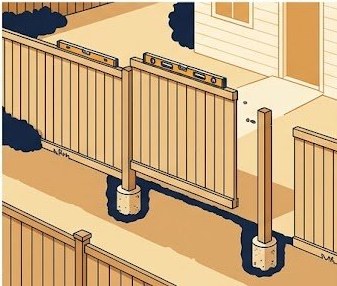
Setting fence posts correctly the first time avoids the most common fence installation problems.
Unlike decks, which almost always require a building permit, fences occupy a grayer area. Many US counties do not require a building permit for standard residential fences — but virtually all counties have zoning rules about fence height and placement that apply regardless of whether a permit is needed. Violating these rules can force you to remove or modify a fence you've already paid to install.
Do You Need a Permit for a Fence?
The answer varies significantly by location:
- No permit required: Unincorporated Wake County (NC), Williamson County (TN), Jefferson County (CO), most Virginia counties — standard residential fences don't need a permit
- Zoning permit required: Orange County (FL) — all fences need a zoning permit (not a full building permit, but still a formal process)
- Building permit required over threshold: Gwinnett County (GA) for fences over 6 ft, Montgomery County (MD) for fences over 6.5 ft, Prince William County (VA) for fences over 6 ft
- Building permit required for all fences: Some individual municipalities — varies widely by city
Height Limits — What Applies Even Without a Permit
Even in counties where no permit is required, zoning ordinances set height limits for fences in different yard zones. The typical rules across most US counties:
- Rear yard: Up to 6–8 feet in height — the most permissive zone
- Side yard: Up to 6 feet in height, sometimes reduced along the street-facing side of a corner lot
- Front yard: Usually limited to 3–4 feet in height. Solid fences in front yards may be restricted to even shorter heights or prohibited entirely in some zones.
These are typical values — your specific county and zoning district may differ. Check your county's zoning ordinance or call your building department to confirm the limits for your parcel.
Corner Lot Visibility Triangles
If you live on a corner lot, visibility triangle requirements significantly limit where you can place a fence. A visibility triangle (also called a sight distance triangle) is a zone near road intersections where fences, hedges, and other obstructions must be kept below a certain height to maintain driver sightlines. Typical requirements:
- No structures or plantings over 2–3 feet high within 15–30 feet of the intersection corner (dimensions vary by county)
- This applies to both fence and mature hedge height
- Violation can create a legal liability if a driver is involved in an accident and claims their sightline was obstructed
Property Line Placement
One of the most common fence disputes is placement on the property line. Most counties allow fences to be placed on the property line with the neighbor's knowledge, but this can create maintenance complications (the fence straddles both properties and both owners have legal claims to it). Some counties require fences to be set back a few inches from the property line.
Before installing a fence, identify your property lines precisely. Survey monuments (metal stakes or pins) should mark the corners of your lot. If you're not sure where your lines are, hire a licensed land surveyor. Installing a fence on your neighbor's property — even by a few inches — can require costly removal and reinstallation.
HOA Fence Rules
In many suburban neighborhoods, a homeowners association (HOA) has additional fence rules beyond the county's zoning requirements. Common HOA fence restrictions include:
- Approved materials (wood only, vinyl only, no chain link)
- Approved colors or stain colors
- Maximum height (often stricter than the county — e.g., 4 feet even in rear yards)
- Required approval from the HOA Architectural Review Committee (ARC) before installation
- Prohibitions on fences in front yards or street-facing side yards
Always check your HOA's CC&Rs (Covenants, Conditions, and Restrictions) before applying for a county permit. HOA approval and county permit approval are completely separate processes — you need both if both apply.
Frequently Asked Questions
- In most US counties, a standard 6-foot privacy fence in the rear yard does not require a building permit. However, this is not universal — some counties require permits for all fences or for fences over a specific height (e.g., 6.5 feet in Montgomery County, MD). You also need to verify your zone's height limit: in some front yard zones, even a 4-foot fence may require a permit. Always check with your specific county.
- In most jurisdictions, you can place a fence on your property line, but both property owners may then have legal interests in the fence. Many homeowners set their fence 2–6 inches inside the property line to avoid ambiguity. Never install a fence without knowing where your property lines are — survey monuments (metal pins) should be at your lot corners. If you're unsure, hire a licensed surveyor before construction.
- Most residential zoning districts limit front yard fences to 3–4 feet in height. Solid fences (like privacy panels) are often prohibited in front yards entirely. Open-style fences (picket, split-rail) are usually allowed up to 4 feet. Check your county's zoning ordinance for your specific zone's rules — the rules in a traditional neighborhood zone may be different from a rural residential zone.
- No. HOA approval and county building permit approval are completely separate processes. Your HOA governs the aesthetic and use rules within your community. The county governs structural safety and zoning compliance. If your county requires a fence permit, you need one regardless of whether your HOA approves the fence design. You may need both HOA approval and a county permit — both, neither, or one — depending on your situation.