Last reviewed: January 2025 · Verify rules with your county before starting any project.
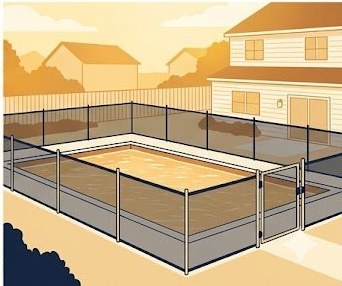
Pool barrier requirements are enforced at the final inspection — the pool cannot be used until the barrier passes.
Of all residential construction projects, swimming pools have the most consistent permit requirements across the country: nearly every US county requires a building permit for both in-ground and above-ground swimming pools. The reason is straightforward — drowning is the leading cause of unintentional death in children under 4, and building codes use pool permits as the mechanism to enforce barrier (fencing) requirements.
Above-Ground Pools — The Common Surprise
Many homeowners assume that above-ground pools, because they're temporary and don't require excavation, don't need permits. This assumption is wrong in most jurisdictions. Most counties require building permits for above-ground pools that are deeper than 24 inches. A standard 48-inch above-ground pool almost certainly requires a permit and a barrier inspection in your county.
What Pool Permits Cover
Pool permits typically involve multiple sub-permits working together:
- Building permit: Covers the structural work — excavation, shell installation, decking around the pool
- Electrical permit: Covers pool pump wiring, bonding, and GFCI requirements. Pool electrical is highly specialized — all wiring must be properly bonded to prevent electrocution
- Plumbing permit: Covers the pump and filter plumbing, drain systems, and water supply connections (if applicable)
- Barrier permit / inspection: Verifies the required fence or barrier around the pool meets code requirements
Pool Barrier Requirements
Every jurisdiction with pool permit requirements also has pool barrier (fencing) requirements. The International Residential Code's baseline barrier requirements:
- Barrier must be at least 48 inches (4 feet) high on the outside
- No openings in the barrier that a 4-inch sphere can pass through
- Gates must be self-closing and self-latching, with the latch on the pool side of the gate
- Gates must open outward (away from the pool)
- No climbable structures within 3 feet of the barrier on the outside
- Door or window alarms required in many states if the house itself serves as one side of the barrier
Many counties have requirements that exceed the IRC baseline. California, Florida, and Arizona have state-level pool safety laws that are stricter than the IRC. Florida, for example, requires a 4-foot barrier around all pools and allows the house to serve as one side only if all windows and doors opening to the pool area are alarmed.
The Pool Permit Process
In-ground pool permits typically involve:
- Pre-construction application with site plan, pool dimensions, and proposed barrier location
- Electrical plan review (often a separate review by the electrical plan reviewer)
- Pre-pour/pre-gunite inspection (for concrete pools) — before the shell is poured
- Barrier inspection — fence and gate must be installed and pass inspection before anyone uses the pool
- Electrical inspection — after all bonding and wiring is complete
- Final inspection — when everything is complete and the pool is ready to fill
Pool Setback Requirements
Pools must be placed within your property's setback lines. In most counties, pools require the same setbacks as accessory structures: 5–10 feet from rear property lines and 5–7.5 feet from side property lines. Pools may not be placed in front yards. The setback is typically measured from the pool's water's edge (not the deck), though some counties measure from the pool shell. Confirm with your county before finalizing your pool location.
Frequently Asked Questions
- Yes, in most jurisdictions. Any above-ground pool deeper than 24 inches (which covers virtually all standard residential above-ground pools) requires a building permit and a barrier inspection in most US counties. The permit process for above-ground pools is usually simpler and less expensive than for in-ground pools, but the barrier requirements are the same.
- The IRC requires a barrier at least 48 inches (4 feet) high on the outside, with no gaps larger than 4 inches. Many states and counties require more — Florida requires 4 feet, California requires 5 feet, and some counties have moved to 5 or 6 feet as their standard. Check your specific county's requirements, as they may exceed the national minimum.
- In many jurisdictions, yes — the exterior wall of the house can serve as one side of the pool barrier if all windows and doors opening to the pool area are equipped with door alarms or self-closing, self-latching gates. The exact requirements vary by county and state. Florida, Arizona, and California have specific requirements for this configuration. Ask your county's building department what's required before designing your barrier.
- Generally no — small inflatable pools under 24 inches deep are typically exempt from building permit requirements. However, if you have a larger inflatable pool (some can be 30+ inches deep), check your county's threshold. The permit requirement is triggered by depth, not whether the pool is permanent or temporary.